
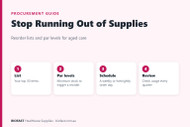
Stop Running Out of Supplies: Reorder Lists and Par Levels for Aged Care
Published by Biofast on 19th Oct 2026
Running out of gloves, continence pads or dressings is stressful for staff and disruptive for residents, and urgent top-up orders often cost more in time and effort. A simple system of par levels and a saved reorder list keeps the essentials on the shelf. This guide is written for aged care managers, clinical leads and procurement staff.
Why facilities run short
- Nobody owns ordering, so stock is only checked when something is missing.
- Usage changes with resident numbers, seasons and outbreaks, but order quantities stay the same.
- Products are ordered from memory, so sizes and variants get mixed up.
- Stock is spread across several storerooms and trolleys, with no single count.
Step 1: Know your usage
For each regular item, note how many you use in a typical week. Start with the items that cause the most trouble when they run out, such as gloves, continence products, wound dressings, wipes and hand rub. A few weeks of rough counts is enough to start.
Step 2: Set par levels
A par level is the amount of an item you want on hand. It is often described with two numbers.
| Level | What it means | Example approach |
|---|---|---|
| Minimum (reorder point) | The level at which you place an order | Enough stock to cover the supplier's delivery time plus a safety buffer |
| Maximum (par) | The most you want to hold, based on storage space and expiry dates | Enough for your usual order cycle, without overstocking |
Review levels every few months, and raise them ahead of winter or when resident numbers change.
Step 3: Build a saved reorder list
A reorder list is the set of products you buy regularly, with the exact product, size and pack quantity for each. Keep one list for the whole facility so that everyone orders the same items. BIOFAST customers can save lists of regular items in their account and reorder them without searching for each product again.
- Group items by area, such as continence, wound care, PPE and personal care.
- Record sizes and variants clearly, for example glove size or pad absorbency.
- Note who is allowed to approve and place orders.
- Update the list whenever a product is changed or discontinued.
Step 4: Make ordering routine
- Schedule a stock check. A weekly or fortnightly walk-through keeps counts current.
- Rotate by expiry date. Put newer stock behind older stock so older items are used first.
- Keep an emergency buffer. Hold a small extra amount of critical items, and check suppliers can dispatch quickly if you need more.
- Use a trade account. An account with payment terms makes regular ordering easier to approve and track.
Ordering regularly from BIOFAST
BIOFAST is a Melbourne-based Australian supplier of continence, wound care, PPE, hand hygiene and personal care products for aged care. Facilities can apply for a 30-day trade account (a completed credit application is required). Orders placed before 2pm normally ship the same day, and delivery is free over $199 in metro areas. Browse aged care supplies, or contact the sales team at sales@biofast.com.au or on 03 8905 4449.
Frequently asked questions
What is a par level in aged care supplies?
A par level is the target amount of an item a facility wants to keep on hand. It is usually paired with a minimum level that triggers a reorder.
How can aged care facilities avoid running out of supplies?
Track usage, set minimum and maximum levels for each item, keep a saved reorder list, schedule regular stock checks and hold a small buffer of critical items.
Can I save a list of regular items to reorder from BIOFAST?
Yes. BIOFAST customers can save lists of regular items in their account and reorder them when needed.
Can aged care facilities buy supplies on account?
Yes. BIOFAST offers 30-day trade accounts to aged care facilities, subject to a completed credit application. Email sales@biofast.com.au to start.