★ Registered NDIS Provider – NDIS participants welcome. See how to order →★ Registered NDIS Provider · How to order →Free delivery over $199 (T&Cs apply)
Tap to order by phone: 03 8905 4449

    *Free delivery over $199 (metro, excl. bulky items)     *Australian Owned and Operated     *Melbourne Based Customer Service     *Tel: 03 8905 4449

Compression Bandages

(Showing 12 of 22)

Compression Bandages

Two-layer compression systems, short-stretch compression bandages and tubular support bandaging for clinics, hospitals and aged care facilities across Australia. Stocked brands include 3M Coban 2, Coban 2 Lite, Comprilan and Tubigrip.

Read More

Assess the arterial supply first

Compression is the treatment for venous disease and the wrong treatment for arterial disease. Applied to a limb with significant arterial insufficiency it can cause pressure damage and tissue loss. Australian and international guidance is that an ankle brachial pressure index or equivalent arterial assessment is carried out before compression is applied, and repeated if the limb changes. Nothing on this page replaces that assessment.

This is a clinician-applied therapy. The decision to compress, the level of compression and the choice of system all follow from the assessment, not from the product.

Short-stretch versus long-stretch

The distinction that matters in practice is resting pressure against working pressure.

Short-stretch (inelastic) bandages such as Comprilan have limited extensibility. They form a semi-rigid cylinder that the calf muscle pushes against during walking, so working pressure is high and resting pressure is low. That makes them well suited to ambulant patients and safer where perfusion is borderline, because the limb is not squeezed hard while the patient sleeps.

Long-stretch (elastic) bandages hold their tension and keep pressure on at rest. They suit immobile patients but carry more risk if left in place unsupervised.

Two-layer cohesive systems

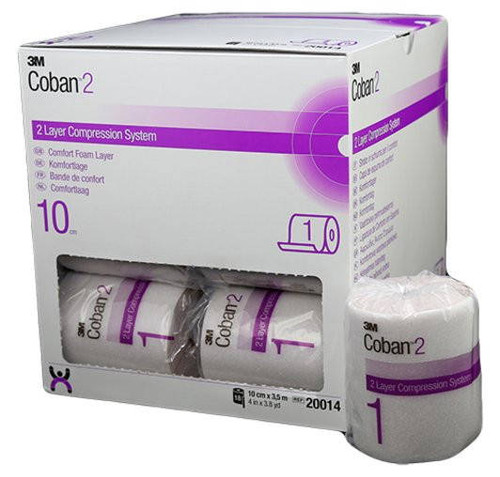
Coban 2 and Coban 2 Lite pair a comfort foam layer with a cohesive compression layer. The two layers bond to each other rather than to skin, which stops the slippage that undermines a traditional multi-layer bandage, keeps the profile thin enough for normal footwear, and allows wear times of up to about a week between changes. Coban 2 Lite delivers reduced compression and is the version used where full compression is not appropriate, including mixed aetiology ulceration with a reduced but acceptable ABPI, and in some lymphoedema regimens.

Why pressure varies along the limb

Sub-bandage pressure rises with bandage tension and the number of layers, and falls as limb circumference and bandage width increase. A narrow ankle therefore receives more pressure than a wide calf from the same bandage applied the same way, which is how graduated compression arises without any extra effort. It is also why limbs of unusual shape need padding to restore a normal cone before bandaging, and why overlap consistency matters more than pulling hard.

Tubular support is not compression therapy

Tubigrip and similar tubular bandages give light support and help with mild oedema, soft tissue injury and holding dressings in place. They do not deliver therapeutic compression and are not a substitute for a compression system in venous ulceration or lymphoedema. Sizing is by limb circumference rather than by garment size, so measure rather than estimate.

Types of Compression Bandaging

  • Two-layer systems: supplied as a kit containing both layers, and as individual comfort foam and compression layers for lymphoedema regimens.
  • Short-stretch bandages: inelastic bandages applied in a spiral or figure-of-eight technique.
  • Cohesive wraps: self-adherent wraps that stick to themselves and not to skin or hair.
  • Tubular: supplied on a roll and cut to length, sized by limb circumference.

Compression bandaging is used in the management of conditions such as venous leg ulcers and lymphoedema. Application requires training, and both the decision to apply compression and the level of compression used should be determined by a qualified clinician following assessment. The information above is general and does not replace that assessment or your organisation's own protocols.

Related Categories

See also bandages, wound dressings and foam dressings, or browse the full wound care range.

Compare
Show 12