Blood Pressure Monitors

(Showing 21 of 21)

Blood Pressure Monitors

Automatic upper arm blood pressure monitors and aneroid sphygmomanometers for clinics, hospitals, aged care and home use, plus replacement cuffs and bladders. Browse Omron blood pressure monitors or Welch Allyn.

  • Buy online, no account needed: anyone can order at the listed price – patients, families, carers and businesses.
  • Trade pricing: open a trade account for wholesale prices; 30-day accounts for aged care homes.
  • Registered NDIS provider: we invoice your plan manager or claim from the NDIA.
  • Fast dispatch from our Melbourne warehouse; free metro delivery over $199 (excluding bulky items).
  • Talk to a real person: call 03 8905 4449 (Mon–Fri 9am–6pm, Sat 10am–3pm) for help choosing a monitor or cuff size, or any problem with an order.
Read More

Cuff size causes more bad readings than the device does

This is the most common and most consequential error in blood pressure measurement, and no amount of money spent on the monitor will fix it.

A cuff that is too small for the arm reads falsely high. A cuff that is too large reads falsely low. The accepted rule is that the inflatable bladder inside the cuff should encircle roughly 80 per cent of the arm circumference and be about 40 per cent of the arm circumference in width. Most monitors are supplied with a standard adult cuff that does not fit a large proportion of real patients at either end of the range.

Measure the mid-upper arm circumference and match it to the range printed on the cuff rather than guessing from build. If a site sees a wide range of patients, a small and a large cuff alongside the standard one is a cheap way to stop a measurable share of readings being wrong. Replacement cuffs and bladders for the Omron professional range are listed in this category.

Technique, in the order it matters

Sit the person for five minutes before measuring, back supported, legs uncrossed, feet flat on the floor. Support the arm so the cuff sits at heart level; an unsupported arm held up by the patient raises the reading, and an arm hanging below heart level raises it further. Apply the cuff to a bare arm, not over a sleeve, and do not roll a sleeve up into a tourniquet above it. Nobody talks during the measurement, including the person taking it.

Take two or three readings a minute apart and average them, discarding the first. A single reading is a snapshot of a variable quantity, and the first one is usually the highest.

Automatic or aneroid

Automatic oscillometric monitors infer blood pressure from pressure oscillations in the cuff. They remove operator variation entirely, which is their main advantage in a busy clinic and the reason they suit home monitoring. Their weakness is irregular rhythm: an irregular pulse, atrial fibrillation in particular, degrades the measurement, which is why some models detect and flag it.

Aneroid sphygmomanometers with a stethoscope remain the reference method in trained hands and do not care about rhythm. They require a trained operator, good hearing and a quiet room, and the gauge drifts, so it needs periodic checking against a reference and recalibration or replacement when it fails. A dial that does not sit at zero with the cuff deflated is telling you something.

Clinic devices and home devices are built differently

Professional units such as the Omron HEM-907 and HBP-1320 are designed for repeated measurement all day, with the cuff durability and duty cycle to match. A consumer monitor used the same way will wear out quickly and its cuff will fail first. Conversely a professional unit is overspecified for a patient taking two readings a day at home.

For home monitoring, look for a device that has been clinically validated rather than one that is simply listed as accurate. Validation lists are published and your prescriber can point to them.

What we stock

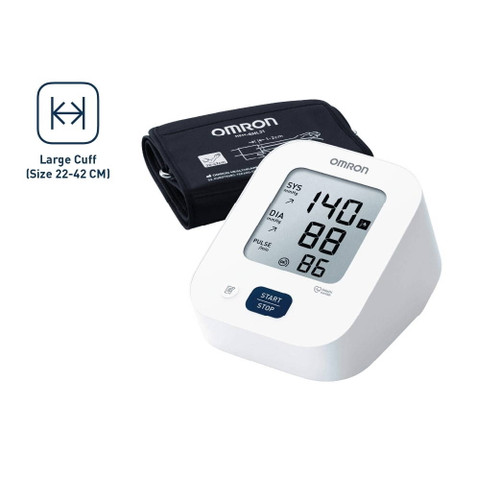
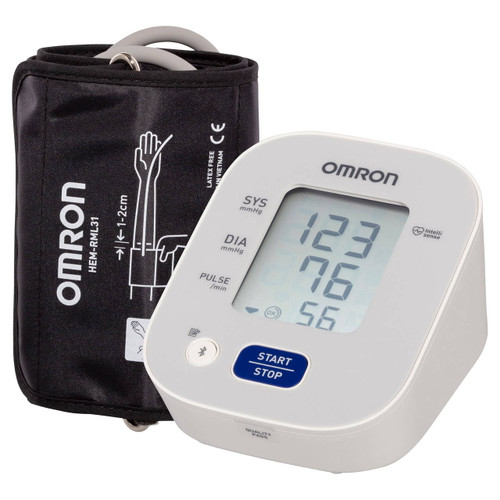
  • Automatic upper arm monitors: the Omron range from basic home models through to professional clinic units.
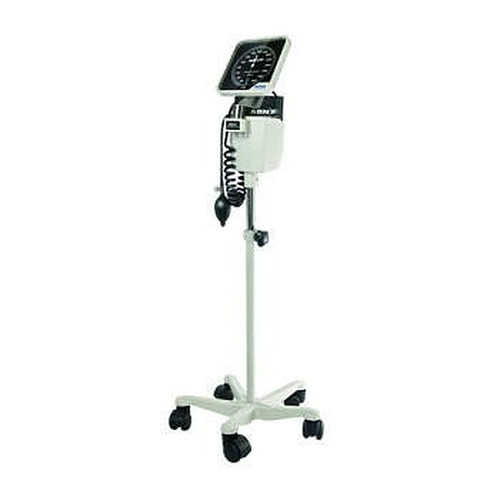
  • Aneroid sphygmomanometers: palm, pocket, desk, wall-mounted and mobile floor models from ABN, Welch Allyn, Riester and Rossmax.
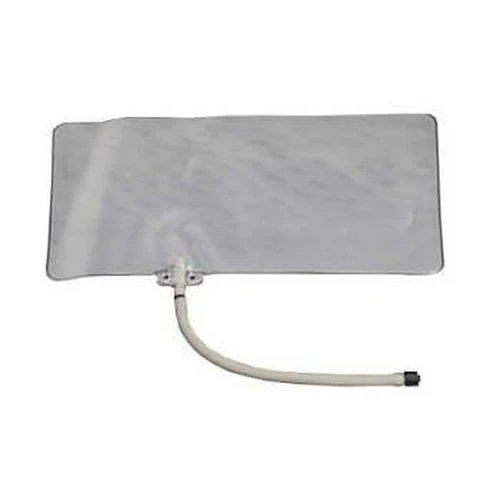
  • Cuffs and bladders: replacement sizes including extra large.
  • Combination sets: aneroid units supplied with a stethoscope.

The guidance above is general information on measurement technique and device selection. It is not clinical advice, and blood pressure readings should be interpreted by a qualified health professional.

Related Categories

See also stethoscopes, ECG and vital signs and diagnostic equipment.

FAQs

Which blood pressure monitor is best for a clinic?

A validated automatic upper-arm monitor with interchangeable cuffs suits most clinics. Busy practices often choose a desktop or wall unit built for heavy use.

What cuff size do I need?

Measure around the middle of the upper arm. The wrong cuff size is the most common cause of inaccurate readings: too small reads high and too large reads low.

Are wrist monitors accurate?

They can be, but readings are more sensitive to wrist position. Upper-arm monitors are preferred for clinical use.

Do you sell replacement cuffs?

Yes. We stock cuffs in several sizes for the monitors we sell. Call us with your model if you are not sure which fits.

Compare
Show 12