★ Registered NDIS Provider – NDIS participants welcome. See how to order →★ Registered NDIS Provider · How to order →

    *Free delivery over $199 (metro, excl. bulky items)     *Australian Owned and Operated     *Melbourne Based Customer Service     *Tel: 03 8905 4449

Lab Coats

(Showing 4 of 4)

Lab Coats

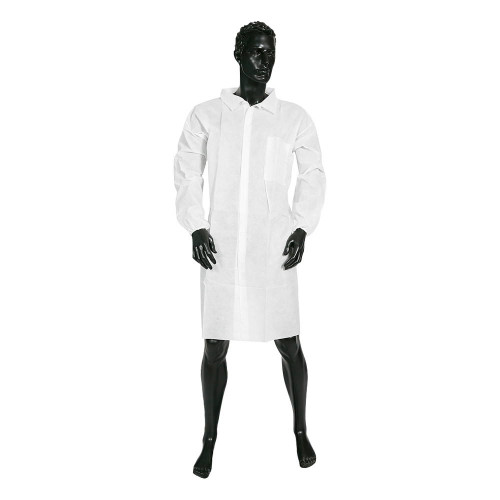
Disposable and reusable lab coats for laboratories, clinics, aged care facilities, food production and education, in polypropylene, SMS and microporous materials, with stud and Velcro closures. Available individually and by the carton.

Read More

Disposable or reusable

The decision is usually about who is wearing it and for how long, not about price per coat.

Reusable coats suit staff who wear one all day, every day. The cost per wear drops quickly, but only if there is a laundering arrangement. If coats go home in staff bags to be washed domestically, you have lost control of both contamination and appearance, and that is a worse outcome than a cheaper disposable.

Disposable coats suit visitors, contractors, auditors, students, short tasks and anywhere cross-contamination between areas matters. They also solve the sizing problem: you hold two or three sizes in a cupboard rather than fitting every occasional visitor.

The material is the specification

Disposable coats are not interchangeable, and the fabric is what separates them.

Polypropylene is the basic non-woven. Light, breathable and inexpensive, it keeps clothing clean and provides a visible barrier for visitors and low-risk work. It offers little resistance to liquids.

SMS (spunbond-meltblown-spunbond) is a three-layer non-woven. The meltblown middle layer adds particle filtration and some fluid resistance while the outer layers keep it strong and breathable. This is the usual choice where there is real work being done rather than a walk-through.

Microporous film laminate bonds a film to a non-woven backing. It gives the highest resistance to splash and fine particles, at the cost of breathability. It is the right choice for messy or dusty work and the wrong choice for a warm room and a long shift.

Closures and cuffs

Stud closures are quick to fasten but can pop open under strain when someone reaches or bends. Velcro closures hold more reliably and are faster to remove, which matters if a coat needs to come off quickly after a spill. Knitted cuffs are worth specifying wherever gloves are worn: they stop the sleeve riding up and let the glove cuff seal over the top, which is where most contamination actually gets onto a wrist.

Size over the clothing that will be worn underneath, not to the person. A coat that is too tight pulls open at the front closure, which defeats the point of it.

When a lab coat is not the right garment

A lab coat is protective clothing, not a fluid barrier. If the task involves a real risk of splash or soaking from blood or body fluids, the garment required is an isolation gown with a fluid-resistant front and sleeves, rated for that purpose. For heavy contamination or whole-body exposure, a coverall is the correct choice. Reaching for a lab coat because it is the thing on the hook is a common and avoidable mistake.

What we stock

  • Disposable polypropylene coats: white, with stud closures, by the carton.
  • Microporous disposable coats: for higher splash and particle resistance.
  • Velcro-seal coats: non-sterile, white, by the carton.
  • Reusable coats: including coloured options for area or role identification.

Related Categories

See also gowns and aprons, hairnets and caps, shoe covers and safety glasses and goggles, or browse all protective wear.

Compare