
How to Choose Wound Dressings for an Aged Care Facility (Australian Buyer's Guide)
Published by Biofast on 19th Oct 2026
Residents in aged care are more prone to skin tears, pressure injuries and slow-healing wounds, so the dressings a facility keeps on the shelf matter. This guide explains how Australian aged care teams can narrow down dressing choices, what to stock as a baseline, and what to check before ordering. It is general product information, not clinical advice: dressing selection for an individual resident should follow your facility's wound management policy and the advice of a wound care nurse or GP.
Start with the wound, not the product
Most facility wound protocols ask the same three questions before a dressing is chosen:
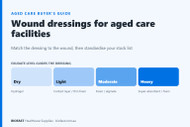
- How much fluid (exudate) is the wound producing? Dry, light, moderate or heavy.
- What is the wound bed like? Clean and granulating, sloughy, or showing signs of infection that need clinical review.
- What is the surrounding skin like? Fragile skin changes how you secure a dressing and how you remove it.
Common dressing types and where they fit
| Dressing type | Typically used for | Things to check |
|---|---|---|
| Non-adherent contact layers (including silicone) | Skin tears and fragile skin where atraumatic removal matters | Needs a secondary dressing to hold it in place |
| Foam dressings | Light to heavy exudate, pressure areas | Size and shape for the body site; bordered or non-bordered |
| Alginates and fibre dressings | Moderate to heavy exudate | Not for dry wounds; needs a secondary dressing |
| Hydrocolloids | Light to moderate exudate, low-risk wounds | Can be hard to remove from very fragile skin |
| Hydrogels | Dry or sloughy wounds needing moisture | Needs a secondary dressing |
| Simple gauze, swabs and tapes | Cleansing, padding and securing | Check sterility and pack size |
A sensible baseline stock list for a facility
Every facility's mix differs, but most keep a range that covers skin tears, pressure area care and routine dressing changes: non-adherent contact layers, a few sizes of bordered and non-bordered foam, an absorbent option for heavier exudate, saline for cleansing, plus swabs, tapes and bandages. Standardising on a short list of products makes staff training and stock control easier, and it makes reordering faster.
What to check before you order
- Pack size. A box of 10 and a single dressing are different products with different prices per unit.
- Sterility and sizing. Match the dressing size to the largest wound you expect to treat, plus overlap.
- Registered brands. Established manufacturers such as 3M, Convatec, Mölnlycke, Smith & Nephew and Hartmann publish clinical product information you can show your wound nurse.
- Supply continuity. Ask whether the product is routinely in stock and how quickly it ships.
Ordering for aged care facilities from BIOFAST
BIOFAST is a Melbourne-based Australian supplier of wound care and medical consumables. Aged care facilities can apply for a 30-day trade account (a completed credit application is required). Orders placed before 2pm normally ship the same day, and delivery is free over $199 in metro areas. Browse the full wound care range, or contact the sales team at sales@biofast.com.au or on 03 8905 4449 to set up an account or ask about product alternatives.
Frequently asked questions
What wound dressings should an aged care facility keep in stock?
Most facilities stock non-adherent contact layers for skin tears, foam dressings in several sizes, an absorbent dressing for heavier exudate, saline for cleansing, and basic swabs, tapes and bandages. Your wound care nurse or facility policy should set the final list.
Which dressings are suited to fragile skin?
Dressings designed for atraumatic removal, such as silicone-based contact layers and soft-adhesive foams, are commonly used on fragile skin. Always follow the manufacturer's instructions and your clinical guidance.
Can aged care providers buy wound care supplies on account?
Yes. BIOFAST offers 30-day trade accounts to aged care facilities, subject to a completed credit application. Email sales@biofast.com.au to start.
How fast can wound care supplies be delivered in Melbourne?
Orders placed before 2pm normally ship the same day, with free delivery on metro orders over $199.