
Sodium Chloride for Injection vs Irrigation: What's the Difference?
Published by Biofast on 12th Oct 2026
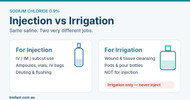
Same saline, two different jobs
Sodium chloride for injection and sodium chloride for irrigation are both sterile 0.9% saline, but they are made, packed and approved for different uses. Irrigation saline must never be injected. Choosing the right one protects patients and avoids paying injection-grade prices for a wound-cleaning job.
This guide explains what each product is, where it is used, and how to pick the right one for your clinic, aged care facility or first aid kit.
What is 0.9% sodium chloride?
Sodium chloride 0.9% is salt dissolved in purified water at 9 mg per mL. It is often called "normal saline" or "isotonic saline" because its salt concentration is close to that of body fluids, at roughly 300 mOsm. That is why it is gentle on tissue and widely used in healthcare.
The active ingredient is identical in both products. The difference lies in the intended route of use, the manufacturing and testing standards, the container, and the approved labelling.
Sodium chloride for injection
Sodium chloride for injection is a sterile, pyrogen-free solution made to go directly into the body by a health professional. In Australia these products are registered medicines on the Australian Register of Therapeutic Goods (ARTG), shown by an AUST R number on the pack.
Common uses
- Diluting or dissolving other injectable medicines before they are given
- Flushing IV lines, cannulas and catheters
- Replacing fluid and salt (larger IV bags, given under medical supervision)
Typical packaging: small single-use plastic or glass ampoules (5 mL, 10 mL, 20 mL), vials, prefilled flush syringes and IV bags.
Because it is manufactured to injection standards, it can also be used to rinse a wound or eye when nothing else is on hand. Some manufacturers list sterile irrigation as a secondary use. It is simply a more expensive way to do that job.
Sodium chloride for irrigation
Sodium chloride for irrigation is sterile, isotonic saline made to wash and rinse tissues, wounds and devices. It is also a registered medicine in Australia, but its label is clear: for irrigation only, not for injection.
Common uses
- Cleansing wounds and removing debris during dressing changes
- Rinsing and soaking dressings
- Irrigating body cavities and tissues during surgical procedures
- Flushing indwelling urinary catheters and surgical drains
Typical packaging: single-use pods or tubes (around 15–30 mL), sachets, and pour bottles from 250 mL to 2 L. Pour bottles and larger formats suit wound clinics, community nursing and aged care, where volume matters.
Irrigation saline is single use. Once opened it is no longer guaranteed sterile, and manufacturers advise discarding any remainder (commonly within 24 hours for pour bottles). Always follow the product label.
Side-by-side comparison
| Sodium chloride for injection | Sodium chloride for irrigation | |
|---|---|---|
| Strength | 0.9% (9 mg/mL) | 0.9% (9 mg/mL) |
| Sterile | Yes | Yes |
| Route | Into the body: IV, IM or subcutaneous | On or into tissue, wounds, cavities and devices |
| Label wording | "Injection" or "for injection" | "For irrigation only. Not for injection." |
| Main uses | Diluting medicines, IV line flushes, fluid replacement | Wound cleansing, surgical irrigation, catheter flushing, soaking dressings |
| Typical packs | 5–20 mL ampoules, vials, flush syringes, IV bags | 15–30 mL pods, sachets, 250 mL–2 L pour bottles |
| Who uses it | Doctors, nurses, paramedics | Nurses, aged care and community care staff, clinics, first aiders |
| Can it do the other job? | Yes, it can be used to irrigate | No, never inject irrigation saline |
| Relative cost per mL | Higher | Lower, especially in larger volumes |
Can you swap one for the other?
The rule only works one way.
- Injection saline for irrigation: acceptable. It meets a higher standard than irrigation requires, so rinsing a wound or eye with a sterile injection ampoule is fine. It is just a costly way to clean wounds day to day.
- Irrigation saline for injection: never. Irrigation products are not tested or approved to go into the bloodstream or tissue, and their containers are not designed for it. Labels state this clearly, and it must be followed.
A few practical safety habits help:
- Check the label for "for irrigation" or "for injection" before every use.
- Store irrigation and injection stock on separate shelves or in clearly labelled bins.
- Do not use a product if the seal is broken, the container leaks, or the solution is cloudy.
- Use each container once and discard what is left, unless the label says otherwise.
- Do not use saline irrigation during electrosurgical procedures, as the product labels advise.
Which one should you stock?
| Setting | Usually needs |
|---|---|
| Aged care facilities | Irrigation pods and pour bottles for routine wound care; injection ampoules only where nurses give injectable medicines |
| GP clinics and medical centres | Both: irrigation for wound care and procedures, injection ampoules and flushes for injectable medicines |
| Community and home nursing | Irrigation pods or small pour bottles for dressing changes |
| Workplace first aid kits | Single-use irrigation pods for eye and wound rinsing |
| Wound care clinics | Larger irrigation pour bottles for high-volume cleansing |
If you are unsure which product fits your clinical protocols, check with your facility's clinical lead or pharmacist before ordering.
Frequently asked questions
Is saline for irrigation the same as saline for injection?
Both are sterile 0.9% sodium chloride, but they are made and approved for different uses. Irrigation saline is labelled not for injection.
Can I use injection ampoules to clean a wound?
Yes. Sterile injection saline can be used to irrigate, though irrigation saline is usually the more economical choice.
Can I keep an opened bottle of irrigation saline for later?
No. Once opened it is no longer guaranteed sterile. Discard any remainder as the label directs.
Is homemade salt water a substitute for sterile saline?
No. Homemade solutions are not sterile and their concentration is uncertain. Use a sterile product for wound care.
Is saline for irrigation the same as saline nasal spray or contact lens solution?
No. These are different products with their own formulations and approvals. Use each only as labelled.
Shop sodium chloride at BIOFAST
BIOFAST Healthcare Supplies stocks sterile sodium chloride for irrigation and injection for aged care, clinics, NDIS participants and workplaces across Australia. Browse our Antiseptics & Wound Cleansing range or our Infusion & Injection range, or contact our team on 03 8905 4449 or sales@biofast.com.au for bulk and trade pricing. Aged care facilities can apply for a 30-day trade account.
This article is general information only and is not medical advice. Always read the label and follow the directions for use. Injectable products should only be used by, or under the direction of, a qualified health professional.