
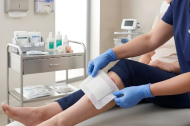
Managing Heavy Exudate: Why Super Absorbent Dressings Matter (Kerramax Care)
9th Mar 2026
Heavy wound exudate can be one of the most uncomfortable (and disruptive) challenges in wound management. When standard pads or foams can’t keep up, leakage, frequent changes, and periwound irritation can become a constant issue. That’s where a Kerramax care super absorbent dressing may be considered—designed to absorb and retain higher volumes of exudate to help reduce strike-through and protect surrounding skin.
Important: This article is general information only and is not medical advice. Always follow product instructions and seek clinical guidance for infected wounds, rapidly increasing exudate, worsening pain, fever, or spreading redness.
What does “super absorbent” mean?
“Super absorbent” dressings are built to manage moderate-to-high levels of wound fluid by pulling exudate away from the wound surface and retaining it within the dressing structure. This can help with moisture balance, comfort, and reducing leakage—especially when exudate levels are consistently high.
Kerramax Care dressings feature a unique wicking layer that distributes fluid both horizontally and vertically, helping the dressing use more of its absorption capacity (not just one saturated “spot”). Exudate is then locked away, including components such as bacteria and MMPs, to support a more stable wound environment.
When are super absorbent dressings typically used?
Super absorbent dressings are often considered for wounds with moderate-to-high exudate where standard absorbent options are not coping well. Common scenarios include:
- Dressings saturating quickly, leading to strike-through or leakage
- Periwound skin irritation or maceration due to excess moisture
- Situations where frequent dressing changes are difficult or disruptive
- Wounds where exudate levels fluctuate and extra absorption capacity is needed
If exudate suddenly increases, treat it as a cue to reassess the wound. A rapid change can be clinically significant and may require review.
Comfort + leakage reduction tips
- Choose enough coverage: Leakage often happens when the dressing is too small. Aim for a dressing size that extends beyond the wound edge (your clinician can advise on the appropriate margin).
- Use conformability to your advantage: Kerramax Care dressings are soft and foldable, which can help with awkward or contoured body areas.
- Prevent edge lift: Most leakage begins at the edges. Secure fixation matters—especially on high-movement areas like knees, ankles, elbows, and hips.
- Protect surrounding skin: If the skin around the wound looks white, soft, sore, or breaks down easily, moisture may be overwhelming the skin. Consider a skin-protection step (as clinically appropriate) and reassess dressing size/absorbency.
- Change based on saturation: Change frequency should reflect exudate levels. If leakage occurs, it’s usually a sign to increase absorbency, increase size, or adjust fixation rather than simply changing more often.
How to choose size (and whether you need a secondary dressing)
Sizes available on Biofast (Box of 10) for 3M Kerramax Care Super Absorbent Dressing include:
- 5cm × 5cm
- 10cm × 10cm
- 10cm × 22cm
- 20cm × 22cm
- 20cm × 30cm
- 20cm × 50cm
Quick selection logic (general):
- Smaller, contained areas: 5×5 or 10×10
- Longer/narrower coverage: 10×22
- Broader coverage for higher output areas: 20×22 or 20×30
- Large areas or when extra margin helps prevent edge leakage: 20×50
Do you need a secondary dressing?
Depending on wound location and your dressing plan, you may use Kerramax Care as a primary or secondary dressing. In practice, a secondary dressing and/or fixation is often used to keep the absorbent layer stable—especially on mobile areas or under compression (where clinically indicated)
If leakage persists despite using a super absorbent dressing, the most common causes are:
- Insufficient dressing size/coverage
- Edge lift or inadequate fixation/outer layer
- Exudate levels that require a different approach (including clinical reassessment)
FAQs
1. What is Kerramax Care super absorbent used for?
It’s typically used to manage moderate-to-high exudate when standard dressings are not coping, particularly where leakage and frequent dressing changes are becoming a problem.
2. What makes a dressing “super absorbent”?
Super absorbent dressings are designed to absorb and retain larger volumes of fluid. Kerramax Care uses a wicking layer to distribute exudate through the dressing and lock it away, helping reduce strike-through and leakage.
3. Can Kerramax Care be left in place for several days?
Depending on the wound condition, exudate level, and clinical judgement, it may be left in place for up to 7 days. Always follow the product instructions and clinical guidance.
4. Why is my dressing still leaking?
Most commonly: the dressing is too small, edges are lifting, fixation is inadequate, or exudate levels have increased and need reassessment.
Shop Kerramax Care on Biofast
View product: 3M Kerramax Care Super Absorbent Dressing (All Sizes) – Box of 10.
References & product information
Biofast product page: 3M Kerramax Care Super Absorbent Dressing – Biofast
Manufacturer product overview (Solventum): 3M™ Kerramax Care™ Super-Absorbent Dressing
Brochure (PDF): Kerramax Care brochure (PDF)